
The Fastest & Easiest Way to Get a Tax Identification Number in Nigeria (Online or Offline) – 2026 Guide
If you’ve ever searched for how to get a Tax Identification Number in Nigeria, you’re not alone. A TIN (Tax Identification Number) is now a common requirement across banks, government agencies, employers, and many business platforms. For a salary earner, a small business owner, a freelancer receiving payments online, or a company registering for taxes, the TIN number often opens the door to formal financial services and compliant tax reporting.
A simple way to think about it: a tax identification number Nigeria is a unique number linked to your tax record. It helps tax authorities and institutions identify you quickly. In 2026, that identification is more important than ever because tax systems are increasingly digital and tied to bank records, government registrations, and business compliance checks. Knowing how to get TIN number and how TIN verification works is therefore useful for everyday life in Nigeria.
Why You Need a TIN — How to Get a Tax Identification Number in Nigeria (Overview)
What a TIN does — real, practical examples
- For a salary earner, employers commonly request a TIN to process PAYE deductions and keep payroll records tidy. If you switch jobs, having a TIN makes the transfer of tax records smoother.
- For an SME or startup, a TIN is needed for formal registration with tax authorities and for claiming certain incentives or exemptions. If the business wants to open a corporate bank account or bid for government contracts, a TIN number is typically required.
- For a freelancer or gig worker paid through platforms (local or international), some payment processors and banks ask for a TIN to comply with Know-Your-Customer (KYC) rules and to help clients issue legitimate invoices.
- For anyone applying for loans, grants, or official permits, a tax identification number Nigeria is frequently part of the required documentation.
These examples show that the TIN is not just a tax office formality, it affects banking, business, and access to government services.
Why TINs matter more in 2026
Over the last few years, Nigerian tax administration has moved toward digital records, cross-checking of bank transactions, and automation. Because of this, TINs now play a central role in linking income, bank activity, and tax filings. The Federal Inland Revenue Service (FIRS) and state tax offices increasingly use TINs to match taxpayer information. For anyone asking “how to get a tax identification number in Nigeria,” understanding that the number is now a practical identity tag for financial life helps put the process in context.
TIN verification — what it means and why it’s useful
TIN verification is the process of checking that a TIN belongs to the person or company claiming it. Verification helps employers, banks, and government bodies avoid mismatches (for example, two people sharing a name). Many services offer online verification tools that accept a TIN and return basic confirmation (e.g., registered name, status). Knowing how to verify a TIN is useful when onboarding employees, accepting a new supplier, or applying for services that require accurate tax records.
High-level overview: How to get a TIN number (the simple path)
Below is a short, non-technical summary of common routes people take when figuring out how to get the Tax Identification Number in Nigeria (TIN):
- Through an employer (salary earners): Many employers initiate TIN registration for new hires who don’t have one. This is often the easiest route for someone paid a regular salary because payroll systems link to the TIN for PAYE.
- Via tax offices (individuals and business owners): Individuals and sole proprietors can register directly with an approved tax portal or physical tax office. A registered TIN helps with personal income tax and record-keeping.
- When registering a company (SMEs): Companies registering with the Corporate Affairs Commission (CAC) or opening a corporate account typically obtain a corporate TIN as part of formalization. This is helpful for company tax exemptions and for meeting compliance requirements.
- Through banks and payment platforms (freelancers/online earners): Some banks and fintech platforms guide customers to register for a TIN to enable higher transaction limits or receive certain services.
This article will later describe the exact steps, typical documents, and common issues encountered during registration, but first it’s helpful to understand the “why” and the typical pathways.
Common questions people have at this stage
- “If I already have a bank account, do I still need a TIN?” — Many banks now ask for a TIN for certain account types or to remove transaction limits.
- “If I earn less than a certain amount, do I still get a TIN?” — Even low earners often find situations (opening a business account, applying for permits) where a TIN is helpful.
- “Does a company have a different TIN from its owner?” — Yes — when a company is registered, it normally gets its own corporate TIN separate from the owner’s personal TIN. This separation is important for tax reporting.
Quick note on safety and compliance language
This guide is explanatory and not professional tax advice. The goal is to help readers understand how to get a tax identification number in Nigeria and why it matters for everyday financial life. Later sections will walk through step-by-step procedures, common documents (IDs, utility bills, CAC paperwork for businesses), how TIN verification works, and tips for avoiding common registration problems.
Step-by-Step — How to Get a TIN Number in Nigeria (Practical Process)
If you’re ready to know how to get a Tax Identification Number in Nigeria, this section walks through the common, practical routes — step by step — for individuals, freelancers, small business owners, and registered companies. Wherever possible the instructions point to official portals and verification tools so you can follow along in 2026 with confidence.
Quick note: multiple official portals now handle Tax IDs and verification. The main, trusted entry points include the national Tax ID portal and the tax authority’s online services. Use the official sites listed here to avoid scams.
A. Two main approaches (choose the one that fits you)
- Retrieve or generate a Tax ID online (fastest for most people).
There’s an official Tax ID portal where individuals and companies can retrieve or generate their Tax ID using identifiers such as National Identification Number (NIN), BVN, or CAC registration number. This is the easiest route for many Nigerians and usually requires only the identifying number plus a few personal details. - Register in person at a tax office (for special cases).
If your details don’t match, you have no NIN or BVN, or the portal asks you to confirm identity, visiting a local tax office (FIRS/NRS, or state tax office) can resolve issues. This route may take longer but is helpful for complicated cases.
B. How individuals typically get a TIN (step-by-step)
- Prepare the key identifiers
Most portals accept either a National Identification Number (NIN) or Bank Verification Number (BVN) for individuals. Have one of these ready plus your valid photo ID (national ID, passport, or driver’s license). - Visit the Tax ID portal
Go to the official Tax ID portal (e.g., the Nigeria Revenue Service / Tax ID page) and choose the Individual or Personal option. Enter your NIN (or BVN) and the other requested details (name exactly as on NIMC records, date of birth). The portal will retrieve a 13-digit Tax ID or guide you to register if none exists. - Follow the on-screen verification
You may be asked to confirm your identity using names and date of birth as recorded with NIMC or your bank. If the information matches, the portal displays your Tax ID; you can save or screenshot it as proof. That screenshot now acts like your certificate. - What if you don’t have a NIN or BVN?
If you do not have a NIN or BVN, the portal may require you to register at a tax office or provide alternate ID. Visiting a local tax office (state tax office or the Nigeria Revenue Service regional office) with identification and a utility bill typically resolves such cases.
C. How companies and SMEs get a corporate Tax ID
- Use your CAC (RC/BN) number
When registering a company, the Corporate Affairs Commission (CAC) registration number (RC/BN) is used to retrieve or generate a corporate Tax ID on the portal. Enter the RC/BN in the Corporate tab to retrieve the Tax ID linked to that company. - Prepare director IDs
Corporate registration sometimes requires the NIN or BVN of company directors. Ensure CAC records match the director details when using the portal. If details don’t match, a trip to the tax office may be necessary. - No new paper certificate necessarily issued
Many official sources now treat the portal result (the 13-digit Tax ID and the verification screen) as the valid record; there is no longer a need to pay for or obtain a separate printed certificate from third parties. Save a screenshot or PDF of the portal result.
D. TIN verification — how others (employers, banks, clients) confirm your TIN
- Official verification pages exist (for example, the tax authority’s TIN verification service) that let a third party check a TIN using the number, RC/BN, or phone number. This tool is used by employers, banks, and vendors to confirm a TIN is active and registered. Use that verification page if someone requests confirmation.
- What to provide when asked: the 13-digit Tax ID, your NIN or company RC/BN, and a screenshot of the portal verification. Many employers accept a screenshot showing the Tax ID and registered name.
E. Quick walkthrough (example scenarios)
1. Salary earner (easy route):
- You have NIN and a bank account. Visit the Tax ID portal, select “Individual”, enter NIN and details, retrieve Tax ID, screenshot it, and share it with your employer payroll team for PAYE processing. This is often faster than waiting for the employer to do it for you.
2. Freelancer paid to a bank or platform:
- If a payment platform requests a TIN for onboarding, use your NIN to retrieve the Tax ID online and upload a screenshot. If the platform wants extra proof, show the verification page or a bank statement that links your name and account to the Tax ID.
3. Small company (SME):
- Use your CAC RC/BN on the corporate tab of the portal to retrieve the company Tax ID. Have directors’ NIN/BVN ready if the portal asks for verification. Save the corporate Tax ID for opening bank accounts, filing returns, and qualifying for small-company tax rules.
F. Common problems & practical fixes
- Name mismatch on portal: Check NIMC (NIN) or bank BVN records. If names differ (marriage, typo), correct the primary record (NIMC or bank) first; then retry retrieval. If correction takes time, visiting a tax office with ID and proof may help.
- No NIN or BVN: Consider quick NIN enrollment options via NIMC or visit a tax office to register while you complete national ID steps. Some people are assisted by banks or employers to fast-track records.
- Old paper TIN certificates: If you have an older TIN certificate (from the previous JTB/FIRS system), the number is often converted to a new format and linked to your NIN or CAC. Use the portal to retrieve your updated 13-digit Tax ID; there’s usually no need to re-register. Save the portal output as your proof.
G. Safety tip: avoid third-party “TIN services”
Some private services charge fees to “get your TIN” for you. The official portals and tax offices generally provide this service for free. Use only official government portals and be wary of anyone asking for payment to issue a TIN.
H. What you should have after registration
After a successful retrieval/registration you should have:
- A 13-digit Tax ID (for individual or corporate) shown on the portal
- A saved screenshot or PDF of the retrieval/verification screen (this acts as proof)
- The ability to share the Tax ID with employers, banks, payment platforms, or clients for onboarding and compliance.
How to Get a Tax Identification Number in Nigeria
Official TIN Application Portals
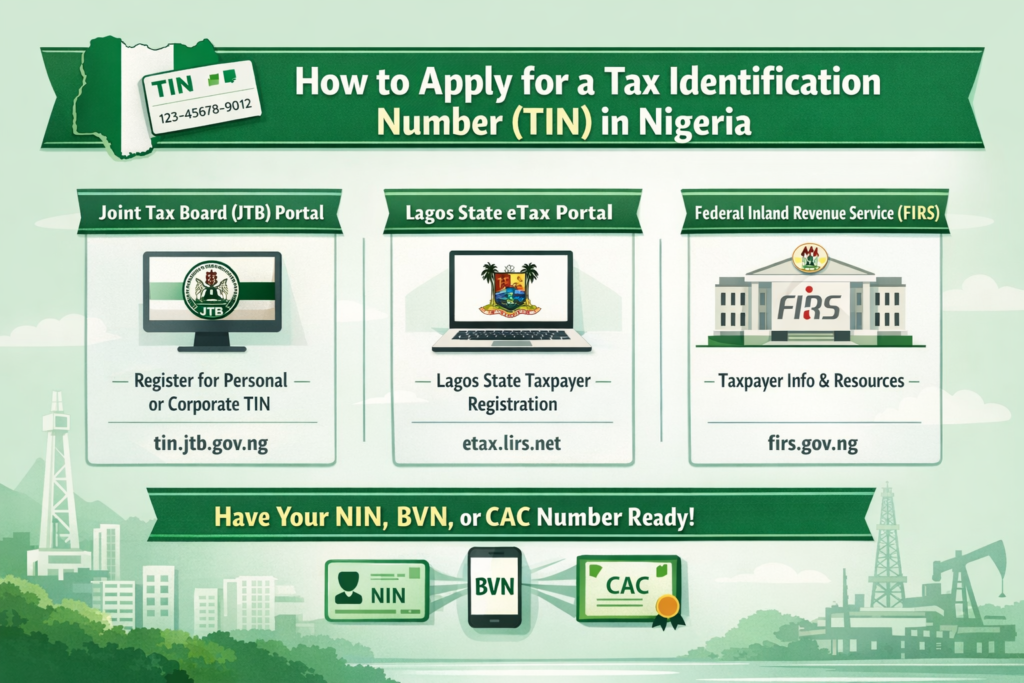
Joint Tax Board (JTB) TIN Registration Portal
This is one of the primary platforms for applying for a personal or corporate tax identification number in Nigeria. You can use it to register for a TIN or check if you already have one:
👉 https://tin.jtb.gov.ng/
State Tax Portals (Example — Lagos State)
If you’re in a specific state like Lagos, you can also use the state tax system to register:
➡️ Lagos State eTax Portal (LIRS) — Register for a taxpayer ID online (individual or business):
👉 https://etax.lirs.net/
Federal Tax Authority Resources
While the Federal Inland Revenue Service (FIRS) itself doesn’t host the main TIN form, it oversees tax administration and links you to registration resources:
➡️ FIRS Individual Income Tax information page:
👉 https://www.firs.gov.ng/individual-income-tax
Optional (Verification)
Once you have your TIN, some services offer verification tools where employers or banks can check your TIN status (e.g., via the JTB portal).
Quick Tips
You normally need one of the following to apply on the portal:
- NIN (National Identification Number)
- BVN (Bank Verification Number)
- CAC registration number (for corporate)
The portal guides you through registering, retrieving, or verifying your TIN.
TIN Verification, Common Issues, FAQs, and Final Summary (Updated for 2026)
After learning how to get a Tax Identification Number in Nigeria and the step-by-step process for registration, the next important area is TIN verification, troubleshooting common problems, and answering the questions Nigerians search for most often. This final section brings everything together and helps you use your tax identification number confidently in real-life situations.
What Is TIN Verification and Why It Matters
TIN verification is simply the process of confirming that a TIN number is valid and correctly linked to a person or a company. In Nigeria, verification has become more common because many institutions rely on accurate tax records to comply with regulations and reduce fraud.
TIN verification is often requested by:
- Employers onboarding new staff
- Banks opening or upgrading accounts
- Government agencies processing applications
- Businesses onboarding vendors or contractors
- Payment platforms verifying user identities
In most cases, verification confirms:
- The name linked to the TIN
- Whether the TIN is active
- Whether it is an individual or corporate TIN
This helps avoid situations where the wrong tax record is attached to a person or company
How TIN Verification Works in Practice
Once you have your tax identification number Nigeria, verification is usually straightforward.
Common ways verification happens:
- Entering the TIN number on an official verification page
- Cross-checking the TIN with a CAC number (for companies)
- Confirming identity details such as registered name
In many everyday cases, simply providing:
- Your TIN number
- A screenshot of the retrieval page
is enough for employers or banks.
For companies, vendors may request:
- Corporate TIN
- CAC registration number
- Director or company details
Verification is not meant to scare taxpayers. It is a confirmation step in an increasingly digital tax environment.
Common Issues People Face With TINs (and Why They Happen)
Even after learning how to get TIN number, some people run into challenges. Most of these issues are administrative rather than serious problems.
1. Name Mismatch
This happens when:
- NIN name differs from bank BVN
- CAC records differ from director details
When systems cannot match names, verification may fail. In such cases, updating the primary record (NIMC, bank, or CAC) usually resolves the issue.
2. Duplicate Records
Some individuals unknowingly have:
- An old TIN from years ago
- A newly generated Tax ID
Modern systems usually merge records once identifiers like NIN or BVN are linked. Duplicate records do not automatically mean wrongdoing.
3. Lost or Forgotten TIN
Many Nigerians forget their TIN after registration. The good news is that TINs are retrievable, not one-time documents. Using identifiers like NIN, BVN, or CAC number usually brings it back.
4. “I Don’t Earn Much — Do I Still Need a TIN?”
This is a common concern. A TIN is not only about how much tax you pay. It is also an identification tool used for:
- Banking
- Business registration
- Employment records
Even if tax due is low or zero, having a TIN is still useful.
TINs for Different Categories of Nigerians
Salary Earners
TINs help:
- Track PAYE deductions
- Transfer tax records when changing jobs
- Simplify payroll processes
Many employees already have a TIN without realizing it.
Freelancers and Online Earners
Freelancers often need a TIN when:
- Receiving payments from platforms
- Issuing invoices
- Opening business accounts
The tax identification number Nigeria helps keep records clean and verifiable.
SMEs and Companies
For businesses:
- Corporate TINs separate business tax from personal tax
- TINs support eligibility for small company exemptions
- Proper records help with compliance as businesses grow
This is especially relevant in 2026 as small business tax rules continue to evolve.
Frequently Asked Questions (FAQ)
1. How do I get a Tax Identification Number in Nigeria?
You can get a TIN by retrieving or generating it through official tax portals using identifiers like NIN, BVN, or CAC registration number. Some employers and banks also assist with the process.
2. Is a TIN the same as a tax clearance certificate?
No. A TIN number is an identification number. A tax clearance certificate shows tax compliance status. They serve different purposes.
3. Is getting a TIN free in Nigeria?
Yes. Official registration and retrieval of a tax identification number is generally free. Be cautious of third parties requesting payment.
4. Can I verify my TIN online?
Yes. TIN verification can be done using official verification tools. Many employers and banks perform this check during onboarding.
5. Does a company need a different TIN from its owner?
Yes. Companies usually have a corporate TIN that is separate from the owner’s personal TIN. This separation helps with accurate tax reporting.
6. What happens if my details change?
If names or details change (for example, after marriage or correction of records), updating the primary records linked to the TIN helps keep verification smooth.
Key Takeaways: How to Get and Use a TIN in Nigeria
Understanding how to get a Tax Identification Number in Nigeria helps remove confusion around tax records and compliance. A TIN:
- Identifies individuals and businesses in the tax system
- Supports banking, employment, and business activities
- Is increasingly important in Nigeria’s digital tax environment
Whether you are a salary earner, freelancer, SME owner, or company director, having and understanding your tax identification number Nigeria makes everyday financial processes easier.
Final Summary
A TIN number is no longer just a tax office reference, it is part of modern financial life in Nigeria. Knowing how to get TIN number, how TIN verification works, and how to fix common issues allows individuals and businesses to operate confidently and transparently.
As Nigeria’s tax system continues to modernize in 2026, awareness and clarity remain key. This guide was created to explain the process in plain language and Nigerian context, not as legal advice, but as practical education.