
Taxes in Nigeria: Types, Rates, Who Pays & How it Works (2026 Guide)
Taxes in Nigeria affect almost everyone, whether you are a salary earner, a small business owner, a freelancer, or a company director. Even if you have never consciously “paid tax,” chances are you have already contributed through everyday activities like buying goods, paying for services, or receiving a salary. Yet, for many Nigerians, tax still feels confusing, intimidating, or overly complicated.
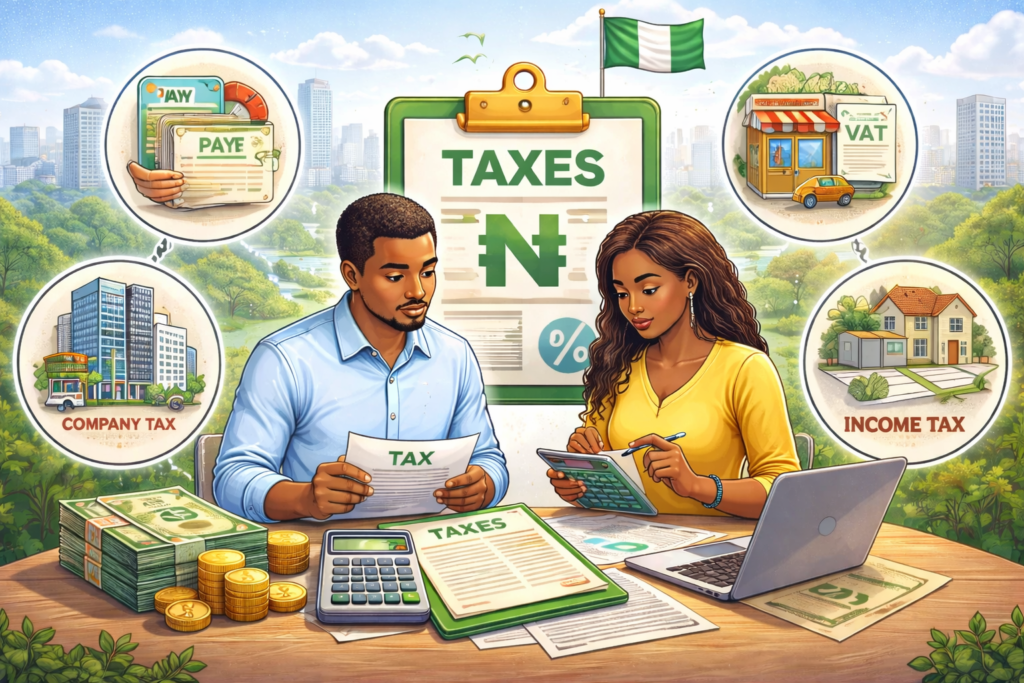
Taxes in Nigeria are no longer a topic people ignore or leave for “accountants and big companies.” In recent years, more Nigerians salary earners, business owners, freelancers, and even side-hustlers have started asking questions about tax in Nigeria and how it affects them personally. This shift didn’t happen by accident. It is closely linked to new tax reforms, stronger enforcement, and growing conversations online about compliance, deductions, and government revenue.
If you have noticed more conversations on social media about PAYE, VAT, TIN, or the Nigerian tax system in general, you are not imagining it. Starting from recent reforms that took effect from January 1, the focus on personal income tax Nigeria, business taxes, and digital income has increased. The goal is simple: broaden the tax net, make collection more transparent, and ensure more people understand how taxes work in Nigeria.
This guide explains taxes in Nigeria in a clear, simple, and practical way. It is written for everyday Nigerians, not lawyers or tax professionals. Whether you earn a monthly salary, run a small business, freelance online, or are simply trying to understand the Nigerian tax system better, this article breaks everything down step by step, using real-life examples in naira (₦) and plain language.
What Are Taxes in Nigeria & Why They Matter
What Are Taxes in Nigeria?
Taxes in Nigeria are mandatory payments that individuals and businesses make to the government from their income, profits, or transactions. These payments are not optional donations. They are part of how the country funds public services and runs government operations.
In very simple terms, when you earn money, sell goods, provide services, or make certain financial transactions in Nigeria, a portion of that value may be collected as tax. This applies whether you are a salary earner, a trader, a freelancer, or a registered company.
The Nigerian tax system is designed so that different types of income and activities are taxed differently. That is why you hear terms like personal income tax Nigeria, company income tax Nigeria, VAT in Nigeria, and PAYE Nigeria explained in different contexts.
Taxes are not collected randomly. They are backed by tax laws in Nigeria, which define:
- Who must pay tax
- What income or transaction is taxable
- How much should be paid
- When and how payment should happen
The details can be complex, but the idea behind tax itself is simple: everyone who earns or transacts within the system contributes a share to public funding.
Why Does the Nigerian Government Collect Taxes?
The Nigerian government collects taxes to fund public services and national development. Without taxes, government operations would rely almost entirely on borrowing or natural resource income, which is unstable and limited.
Tax revenue is used to support things that affect everyday life, including:
- Road construction and maintenance
- Public schools and universities
- Government hospitals and healthcare programs
- Security agencies and public safety
- Power, transportation, and infrastructure projects
When you hear discussions about “tax awareness” or “broadening the tax base,” it is largely about ensuring that more economic activity contributes to these shared responsibilities.
Taxes also help the government plan. When revenue is predictable, budgets can be made more realistically. This is one reason why Nigeria has been pushing for better tax records, digital tracking, and identification systems in recent years.
How Taxes Support Public Services (Real-Life Context)
Think of taxes as a shared pool. Every time taxes are paid, whether through PAYE deductions, VAT on goods, or company taxes, that money goes into funding public needs.
For example:
- A salary earner paying PAYE contributes indirectly to public schools and hospitals.
- A small business charging VAT on products helps fund government infrastructure.
- A registered company paying company income tax supports national development programs.
While many Nigerians understandably question how effectively tax money is used, the purpose of taxation itself is not punishment. It is meant to support shared services that individuals cannot easily provide on their own.
Understanding how tax works in Nigeria helps people move from confusion to awareness, even if they still expect better accountability from government.
How the Nigerian Tax System Works (High-Level Overview)
The Nigerian tax system or taxes in nigeria operates at different levels of government:
- Federal
- State
- Local
Each level has specific taxes it is responsible for. This is why some taxes are deducted from salaries by employers, some are paid directly by businesses, and others appear automatically during transactions.
At the federal level, tax collection and administration are overseen by bodies such as the Federal Inland Revenue Service (commonly known as FIRS). FIRS handles major federal taxes like company income tax, VAT, and some withholding taxes.
States also play a major role, especially when it comes to personal income tax Nigeria, which applies to individuals earning income within a state.
The system is designed so that:
- Employers deduct certain taxes on behalf of employees
- Businesses collect some taxes from customers and remit them
- Individuals and companies file returns based on their income or activity
While the structure may seem complicated at first, the logic behind it is consistency and record-keeping.
Why Tax Awareness Is Increasing in Nigeria (Updated for 2026)
More Nigerians are paying attention to taxes now than ever before. Several factors are driving this shift.
First, recent tax reforms and policy updates (introduced and strengthened between 2024 and 2026) have focused on expanding compliance rather than increasing rates. The goal has been to bring more people and businesses into the formal tax net, especially those operating digitally or informally.
Second, enforcement has become more data-driven and digital. Bank transactions, business registrations, TIN usage, and online payments have made it easier for authorities to identify taxable activities. This does not mean everyone is suddenly being taxed heavily, it means the system is becoming more visible.
Third, social media and online discussions have played a big role. Conversations around:
- “Who pays tax in Nigeria?”
- “Do freelancers pay tax?”
- “Why is VAT everywhere?”
have pushed tax topics into everyday discussions, especially among young professionals and entrepreneurs.
Finally, economic pressure has made people more curious. As living costs rise, Nigerians want to understand why deductions exist and what they are for, rather than ignoring them.
Why Understanding Taxes in Nigeria Matters for Individuals
You do not need to be a tax expert to benefit from tax knowledge. Understanding taxes in Nigeria helps you:
- Read your payslip with confidence
- Understand business expenses and pricing
- Avoid confusion when dealing with banks or government agencies
- Make sense of VAT charges on goods and services
This guide does not aim to turn you into a tax consultant. Its goal is to help you understand how the system works, who pays what, and why it exists, without fear or complexity.
Types of Taxes in Nigeria (Explained Simply)
When people talk about taxes in Nigeria, they often imagine one big, confusing deduction. In reality, the Nigerian tax system is made up of different types of taxes, each designed for a specific kind of income or transaction. Understanding these categories makes tax in Nigeria feel far less intimidating.
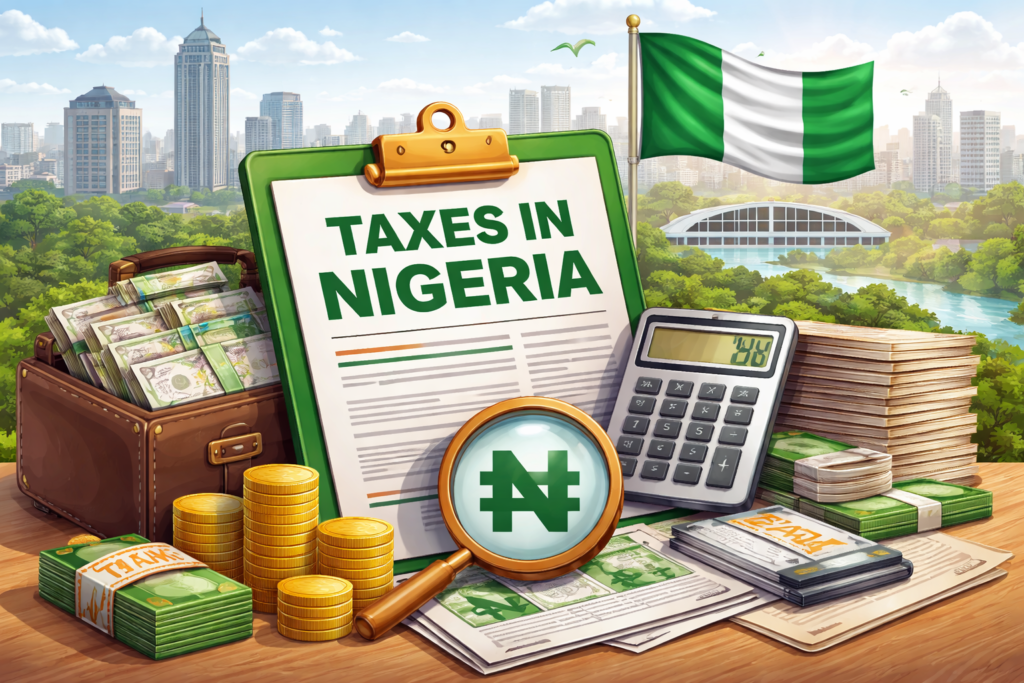
This section explains the main types of taxes in Nigeria, who pays each one, what they apply to, and how they work in real life, using everyday Nigerian examples and ₦ amounts. This is not legal language, just plain explanations.
1. Personal Income Tax (PIT)
Personal Income Tax (PIT) is the tax paid by individuals on their income. If you earn money as a person — not as a registered company — this is the tax category that applies to you.
Who pays Personal Income Tax in Nigeria?
- Salary earners
- Self-employed individuals
- Freelancers
- Sole proprietors
- Professionals (designers, writers, consultants, artisans, etc.)
What income does it apply to?
Personal income tax Nigeria applies to:
- Salaries and wages
- Business profits (for individuals)
- Professional fees
- Allowances and bonuses (with some exclusions)
How is it collected?
For many people, PIT is collected automatically through PAYE (explained below). For others, especially self-employed individuals, it is assessed based on declared income.
General rate (simple view)
Nigeria uses a graduated system, meaning:
- Lower income → lower tax rate
- Higher income → higher tax rate
Rates generally range from single-digit percentages up to about 24%, depending on income level, after allowed deductions.
Simple example:
If a self-employed graphic designer earns ₦3,600,000 per year, tax is calculated on the taxable portion after deductions. The tax paid is not a flat amount, it increases gradually based on income bands.
PAYE (Pay As You Earn)
PAYE (Pay As You Earn) is not a separate tax — it is a method of collecting personal income tax from salary earners.
Who pays PAYE?
- Employees working in private companies
- Government workers
- Anyone earning a regular salary
How PAYE works (PAYE Nigeria explained)
Instead of paying tax once a year, PAYE allows tax to be:
- Calculated monthly
- Deducted directly from your salary
- Remitted by your employer
This means the employee does not need to make separate payments every month.
What PAYE applies to:
- Monthly salary
- Allowances included in pay
Simple example:
If your monthly salary is ₦300,000, your employer calculates the applicable tax for that month and deducts it before paying your net salary. If PAYE is ₦25,000, you receive ₦275,000.
PAYE is one of the most common ways Nigerians interact with tax, often without realizing it.
2. Company Income Tax (CIT)
Company Income Tax (CIT) applies to registered companies, not individuals.
Who pays Company Income Tax in Nigeria?
- Limited liability companies
- Registered corporate entities
Sole proprietors and freelancers do not pay company income tax unless they operate as registered companies.
What does it apply to?
- Company profits
- Income earned from business operations
General rate (simple view)
- Standard rate is around 30% of taxable profit
- Smaller companies may pay reduced rates or none, depending on profit size
Simple example:
If a registered company makes ₦20,000,000 profit in a year, company income tax may be calculated as a percentage of that profit after allowable expenses.
Company income tax Nigeria is handled separately from personal income tax.
Value Added Tax (VAT)
VAT in Nigeria is a consumption tax, not an income tax.
Who pays VAT?
- Consumers ultimately pay VAT
- Businesses collect VAT on behalf of government
What does VAT apply to?
- Sale of goods
- Provision of services
VAT is currently charged at 7.5% on most taxable goods and services.
How VAT works:
When you buy something, VAT is added to the price. The business collects that VAT and later remits it.
Simple example:
If a product costs ₦10,000, VAT is ₦750.
Total amount paid = ₦10,750
VAT is one of the most visible taxes because it appears on receipts and invoices.
Withholding Tax (WHT)
Withholding Tax is a tax deducted at source when certain payments are made.
Who pays it?
- Businesses and individuals making specific payments
- The person receiving the payment gets the net amount
What does it apply to?
- Professional fees
- Contract payments
- Rent
- Commissions
General rate (approximate)
Rates vary but often range from 5% to 10%, depending on the transaction.
Simple example:
If a consultant invoices ₦200,000 and withholding tax is 10%, the payer deducts ₦20,000 and pays ₦180,000.
The withheld amount is credited against the consultant’s annual tax.
Capital Gains Tax (CGT)
Capital Gains Tax applies when you sell an asset for profit.
Who pays it?
- Individuals
- Businesses
- Companies
What does it apply to?
- Sale of land
- Sale of buildings
- Sale of shares or investments
General rate:
- About 10% of the gain
Simple example:
If you bought land for ₦2,000,000 and sold it for ₦3,000,000, the gain is ₦1,000,000. Capital gains tax may apply to that gain.
Stamp Duties
Stamp duties apply to legal and financial documents.
Who pays it?
- Individuals
- Businesses
What does it apply to?
- Agreements
- Transfers
- Certain bank transactions
Simple example:
Some bank transfers or official documents attract small stamp duty charges, usually fixed amounts rather than percentages.
Why Understanding the Types of Taxes in Nigeria Matters
Knowing the list of taxes in Nigeria helps you:
- Understand why deductions exist
- Avoid confusion when charges appear
- Separate personal taxes from business taxes
- Know which taxes apply to your situation
Many people fear taxes simply because they do not know which ones apply to them. Clarity removes fear.
Who Is Required to Pay Tax in Nigeria?
One of the most common questions Nigerians ask about taxes in Nigeria is simple: “Do I actually need to pay tax?”
The confusion is understandable. Many people believe tax is only for big companies, government workers, or people earning millions. In reality, the Nigerian tax system is broader, but also more logical, than most people think.
This section explains who pays tax in Nigeria, using real-life situations and everyday income types. No threats, no scare tactics, just clear facts.
1. Salary Earners (Employees)
If you earn a regular salary in Nigeria, you are required to pay tax.
Who falls into this category?
- Private sector employees
- Government workers
- Contract staff on monthly pay
- Anyone receiving consistent wages or salary
How salary earners pay tax
Most salary earners pay tax through PAYE (Pay As You Earn). This means:
- Tax is calculated automatically
- It is deducted from your salary
- Your employer sends it to the tax authority
This is why many employees pay tax without ever filing forms themselves. You may not even notice it beyond a line on your payslip.
Common misconception
Some people believe that if their employer handles PAYE, they are “not paying tax.” In reality, PAYE is personal income tax Nigeria, just collected on your behalf.
2. Business Owners & SMEs
If you run a business in Nigeria, even a small one, tax obligations usually apply.
Who qualifies as a business owner?
- Shop owners
- Online sellers
- Service providers
- Traders and vendors
- SMEs (Small and Medium Enterprises)
What taxes apply to businesses?
This depends on how the business is structured:
- Individuals or sole proprietors pay personal income tax on profits
- Registered companies pay company income tax Nigeria
- Businesses may also collect VAT in Nigeria on eligible goods or services
Example:
If you run a fashion business and make ₦500,000 profit in a month, that profit is considered taxable income. The tax is not based on revenue alone but on profit after business expenses.
Important clarity
You do not need to be “big” to be taxable. Size affects how much you pay, not whether you are required to pay.
3. Freelancers & Self-Employed Individuals
Freelancers often ask, “I work online — do I still pay tax in Nigeria?”
The simple answer: yes, income is income, whether online or offline.
Who is considered self-employed?
- Freelancers (designers, writers, developers, editors)
- Consultants
- Content creators
- Coaches and trainers
- Independent professionals
How tax applies
Freelancers typically pay:
- Personal income tax
- Based on annual income
- After allowable deductions
Unlike salary earners, freelancers usually:
- Declare their income themselves
- Pay tax directly rather than through PAYE
Common fear
Many freelancers worry that declaring income will automatically lead to “huge tax bills.” In reality, the Nigerian tax system is graduated, meaning lower income attracts lower tax.
4. Registered Companies
If a business is registered as a company, its tax obligations are separate from the owner’s personal taxes.
What counts as a registered company?
- Limited liability companies
- Corporate entities registered under Nigerian law
What taxes apply?
- Company income tax
- VAT (where applicable)
- Withholding tax on certain transactions
Company taxes are handled at the federal level and overseen by bodies like the Federal Inland Revenue Service.
Important distinction
A company’s profit is taxed separately from the personal income of its directors or owners.
5. Nigerians Earning Foreign Income (High-Level Explanation)
With remote work and online payments, more Nigerians now earn income from outside the country.
Does foreign income attract tax?
In general:
- Nigerian residents may be required to declare income earned globally
- This includes foreign freelance work, contracts, or services
However, tax treatment can depend on:
- Residency status
- Nature of income
- Existing agreements
This area often causes confusion, which is why awareness has increased recently. The key takeaway is that location of payment does not automatically remove tax responsibility.
People Who Think They Are “Too Small” to Pay Tax
A very common belief in Nigeria is:
“I don’t earn enough to pay tax.”
In practice:
- Very low income earners may pay little or no tax
- But earning income still places you within the system
Tax laws in Nigeria allow for:
- Deductions
- Reliefs
- Income thresholds
So being in the tax system does not mean heavy taxation.
Who Does NOT Usually Pay Certain Taxes?
For taxes in nigeria — not everyone pays every tax.
For example:
- Salary earners do not pay company income tax
- Sole proprietors do not pay company income tax
- Consumers do not remit VAT directly
- Businesses do not pay PAYE for themselves
Understanding which taxes apply to you prevents unnecessary worry.
Why This Clarity Matters
Many people fear taxes because they assume:
- Tax means trouble
- Tax means punishment
- Tax means government targeting
In reality, tax in Nigeria is structured around income type and activity, not intimidation.
Knowing who pays tax in Nigeria helps you:
- Understand your obligations calmly
- Separate myths from facts
- Avoid confusion when deductions appear
How Tax Is Calculated in Nigeria & What Happens If You Don’t Pay
After understanding the types of taxes in Nigeria and who is required to pay them, the next big question is usually:
“How is tax actually calculated, and what happens if someone doesn’t pay?”
This section breaks it down in the simplest possible way — no formulas, no legal language, just how tax works in real life for everyday Nigerians. This version is updated for 2026 and reflects how the Nigerian tax system currently operates in practice.
How Tax Is Calculated in Nigeria (Simple Breakdown)
At its core, tax calculation in Nigeria follows a basic flow:
Income → Allowed deductions → Taxable income → Tax due
The key thing to understand is this:
👉 You are not taxed on everything you earn.
You are taxed on what is considered taxable income after certain deductions.
1. Personal Income Tax Calculation (Salary Earners)
For salary earners, tax is usually calculated using PAYE (Pay As You Earn).
Step-by-step (simplified):
- Your total salary is identified
- Certain reliefs and deductions are applied
- The remaining amount is taxed using graduated rates
- The tax is spread monthly and deducted from your salary
Simple PAYE example:
- Monthly salary: ₦300,000
- Annual salary: ₦3,600,000
- After reliefs and deductions, tax is calculated
- Monthly PAYE deduction: ₦25,000 (example)
So instead of paying a lump sum, you pay gradually every month.
This is why many salary earners don’t feel the “weight” of tax — it is built into payroll.
2. Personal Income Tax Calculation (Self-Employed & Freelancers)
For freelancers and self-employed individuals, the process is slightly different.
General process:
- Total annual income is declared
- Business-related expenses may be deducted
- Reliefs are applied
- Tax is calculated on the remaining amount
Example:
- Annual freelance income: ₦4,800,000
- Business expenses: ₦1,200,000
- Remaining amount: ₦3,600,000
Tax is then calculated on that ₦3,600,000, using graduated rates.
This system is designed so lower earners pay less, while higher earners contribute more.
3. VAT Calculation (Businesses & Consumers)
VAT in Nigeria works differently from income tax.
- VAT rate: 7.5%
- It applies to goods and services
- The consumer pays, the business collects
VAT example:
- Service price: ₦50,000
- VAT (7.5%): ₦3,750
- Total paid by customer: ₦53,750
The business keeps ₦50,000 and remits ₦3,750 as VAT.
VAT is not the business’s income — it is collected on behalf of government.
4. Company Income Tax Calculation (High-Level)
For registered companies:
- Total revenue is recorded
- Allowable business expenses are deducted
- Profit is calculated
- Company income tax Nigeria applies to the profit
Small companies may pay reduced rates or none at all, depending on profit level.
How to Pay Taxes in Nigeria (Very Important)
Understanding how to pay tax removes a lot of anxiety.
Common ways taxes are paid:
- PAYE: Automatically deducted by employers
- Direct payment: Individuals and businesses pay assessed amounts
- VAT remittance: Businesses remit collected VAT
Payments are usually made through:
- Designated banks
- Online platforms
- Government-approved payment systems
Federal taxes are overseen by the Federal Inland Revenue Service, while states handle personal income tax for individuals within their jurisdictions.
You do not need to “know someone” to pay tax. The system is increasingly digital and structured.
What Happens If You Don’t Pay Tax in Nigeria?
This is often where fear and misinformation spread. Let’s be clear and factual.
If tax is not paid, possible outcomes include:
- Accumulated penalties
- Fines
- Interest on unpaid amounts
- Enforcement actions such as notices or restrictions
These actions are procedural, not personal. They are designed to encourage compliance, not intimidation.
Important clarity:
- Non-payment does not automatically mean jail
- Issues usually start with assessments and notices
- Many cases are resolved through compliance, not punishment
Understanding how tax works in Nigeria reduces unnecessary fear.
Frequently Asked Questions (FAQs)
1. Is tax compulsory in Nigeria?
Yes. Tax is compulsory for individuals and businesses that earn taxable income in Nigeria. The obligation is based on income type and activity, not personal choice. However, the amount paid depends on earnings, deductions, and applicable rates.
2. How much tax do salary earners pay in Nigeria?
Salary earners pay personal income tax through PAYE. The amount depends on income level, reliefs, and deductions. Lower earners pay less, while higher earners pay more due to the graduated system.
3. Do small businesses pay tax in Nigeria?
Yes, small businesses are part of the Nigerian tax system. Sole proprietors usually pay personal income tax on profits, while registered companies may pay company income tax. Size affects the amount, not the obligation.
4. Can someone go to jail for not paying tax in Nigeria?
Tax issues are generally handled through assessments, penalties, and enforcement processes. Jail is not the default outcome. Most cases focus on compliance and resolution rather than punishment.
5. How do I get a TIN in Nigeria?
A Tax Identification Number (TIN) is used to track tax records. It can be obtained through approved government channels and is required for many tax-related activities. It is now commonly requested by banks and businesses.
Summary: Understanding Taxes in Nigeria (2026)
Taxes in Nigeria are a structured system designed to fund public services and national development. Different taxes apply to different income types, salaries, business profits, transactions, and consumption.
By understanding:
- The types of taxes in Nigeria
- Who pays tax in Nigeria
- How tax is calculated
- How payments are made
tax becomes less confusing and less intimidating.
This guide was written to provide clarity, not advice, and to help Nigerians understand how the Nigerian tax system works in real life.