
Is Tax Avoidance Legal in Nigeria? Understanding the Difference from Tax Evasion in 2026
In Nigeria, tax avoidance means using legal methods to minimize the tax you owe. For example, employees pay Pay-As-You-Earn (PAYE) tax on their salaries and companies pay Company Income Tax (CIT) on profits – all collected by the Federal Inland Revenue Service (FIRS) . Since taxes like PAYE and CIT can be a big expense, many Nigerians look for legal ways to lower their bills. Simply put, tax avoidance is the legitimate, law-abiding way to reduce tax. It’s often defined as “the practice of legally trying to pay as little tax as possible” . In the current Nigerian tax system, that might mean claiming every allowable deduction, relief or exemption the law provides.
The Nigerian tax context includes several main taxes: personal income tax (handled via PAYE for workers) and corporate income tax for businesses. Under recent reforms, the tax authority FIRS (now the Nigeria Revenue Service) has also updated rules and thresholds. For instance, new laws exempt low earners from PAYE – anyone earning ₦800,000 or less a year pays 0% tax – and small companies under ₦50 million turnover pay no CIT . These changes reflect the idea of legal tax planning: adjusting income or claiming incentives so that you owe less tax. Nigerians care about tax avoidance because it helps citizens and businesses keep more money, while staying on the right side of the law .
Avoidance vs Evasion: Key Differences
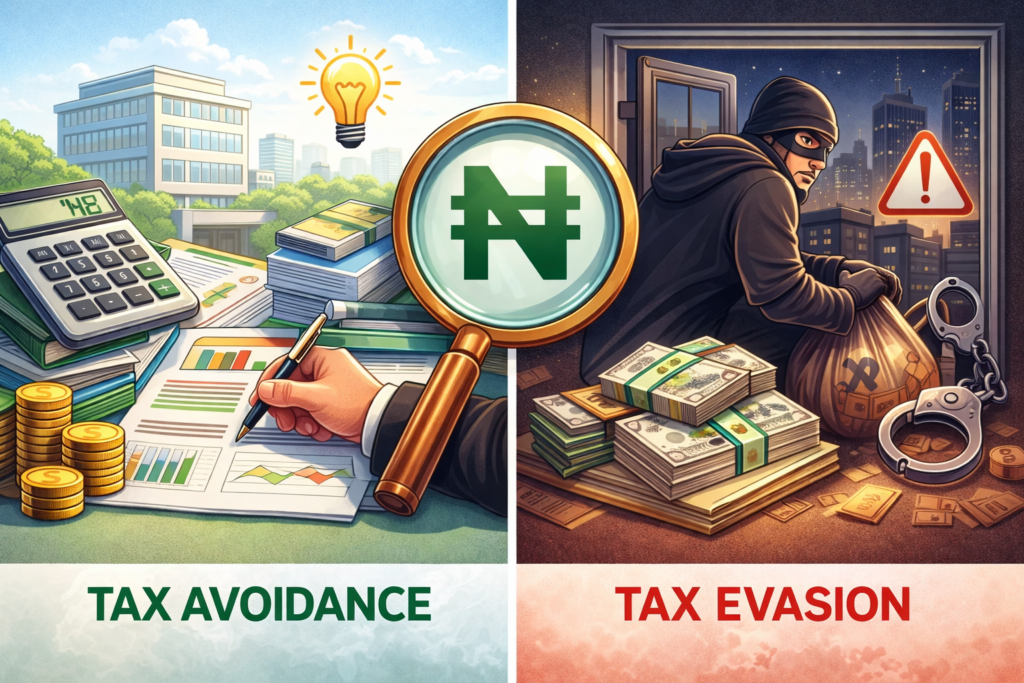
It’s important to distinguish tax avoidance from tax evasion. Tax avoidance is perfectly legal – it means arranging your finances so that you pay the least tax allowed under Nigerian law. In contrast, tax evasion is illegal: hiding income or falsifying records to cheat the taxman. As one Nigerian legal insight explains, the difference “lies in the legality of tax avoidance and the illegality of tax evasion”. In practical terms, avoidance might involve claiming a relief or structuring transactions within the tax rules, whereas evasion involves fraud (for example, under-reporting sales or not filing returns at all).
Under Nigerian law, tax evasion is specifically outlawed. For example, failing to remit PAYE deductions for employees is considered a crime. Tax evasion can lead to penalties or even jail time. By contrast, tax avoidance is encouraged. Courts in Nigeria have stated that taxpayers are “entitled to be astute” in using every legal loophole to lessen their tax burden. In short, tax avoidance follows the rules (often by taking full advantage of them), while tax evasion breaks the rules. Many advisers simply put it this way: if it’s in the law, it’s avoidance; if it’s under the table, it’s evasion.
How This Guide Helps You
In this guide, we will explain what tax avoidance and tax evasion mean for Nigerians, and how to tell them apart. We’ll use real examples (in simple terms) to make the concepts clear. Importantly, we will also cover legal tax reduction strategies – that is, steps Nigerians can take to reduce tax bills without breaking the law. For instance, under current Nigerian tax law you can claim various allowances and reliefs (like pension contributions, housing relief, or equipment deductions) to cut your taxable income. Businesses can also use official incentives: many small companies (turnover ≤ ₦50m) now pay 0% CIT, and there are special tax breaks for startups and investors.
By following the rules, Nigerians can enjoy these company tax exemptions and personal reliefs as intended. Throughout the article, we’ll explain these legal options – from Nigeria small business tax breaks to individual deductions – and show how they fit the definitions of tax avoidance. We will not advise on any illegal schemes; our focus is strictly educational. By the end of this section, you’ll understand the basics: tax avoidance is using lawful measures to pay less tax, tax evasion is illegal cheating, and smart taxpayers use only the former. The next sections will go into more detail on examples and legal differences, helping you learn how to legally reduce taxes in Nigeria without stepping over the line.
What Is Tax Avoidance in Nigeria?
Meaning of Tax Avoidance in Nigeria (Simple Explanation)
Tax avoidance in Nigeria refers to the use of legal methods, structures, and provisions allowed by Nigerian tax laws to reduce the amount of tax a person or business pays. It does not involve hiding income, falsifying records, or refusing to pay taxes. Instead, it involves understanding how the tax system works and operating within it.
In simple terms, tax avoidance means paying what the law requires — and nothing more.
This is an important distinction because Nigerian tax laws themselves provide several reliefs, exemptions, thresholds, and incentives. These provisions exist deliberately to:
- Encourage business growth
- Support small companies
- Promote formal registration
- Reduce the burden on low-income earners
When individuals or businesses use these provisions correctly, they are engaging in legal tax reduction, not wrongdoing.
Why Tax Avoidance Exists in the Nigerian Tax System
Many people assume the government wants to collect as much tax as possible from everyone. In reality, the Nigerian tax system is designed to balance revenue generation with economic growth.
Tax avoidance exists because:
- Small businesses need room to grow
- New companies require incentives
- Low-income earners should not be overburdened
- Formal registration should be encouraged
That is why Nigerian tax laws contain:
- Income thresholds
- Tax-free allowances
- Company tax exemptions
- Reduced tax rates for certain categories
Using these provisions is part of normal tax planning.
Common Legal Ways to Reduce Tax in Nigeria (Overview)
When people talk about how to legally reduce taxes in Nigeria, they are usually referring to one or more of the following lawful approaches:
- Structuring income correctly
- Registering the appropriate business type
- Keeping proper financial records
- Claiming allowable deductions
- Benefiting from exemptions written into the law
None of these methods involve secrecy or deception. They rely on transparency and compliance.
Business Registration and Tax Avoidance
One of the most common and legitimate tax avoidance strategies in Nigeria is proper business registration.
Individual vs Company Structure
How income is taxed often depends on how the business is structured:
- Individuals / sole proprietors are taxed under personal income tax
- Registered companies are taxed under company income tax
Choosing the appropriate structure affects:
- Applicable tax rates
- Eligibility for exemptions
- Reporting requirements
This is not manipulation — it is how the system is designed.
Small Company Exemption (Very Important for 2026)
Under Nigerian tax laws effective into 2026, small companies may be exempt from Companies Income Tax (CIT) if they meet certain criteria.
While exact thresholds are defined in legislation, in practical terms:
- Companies with annual turnover below ₦50 million
- And within prescribed asset limits
may fall under the small company category.
What this means in practice:
If such a company:
- Is properly registered
- Keeps accurate records
- Files required returns
it may legally pay 0% company income tax on its profits.
This is not tax evasion.
It is a deliberate tax incentive created to support small businesses.
The company is not avoiding tax illegally — the tax law itself says no tax is due at that level.
This is one of the clearest examples of tax avoidance in Nigeria being fully legal and encouraged.
Allowable Deductions and Reliefs
Another major area of tax avoidance involves allowable deductions.
For individuals, taxable income is not always the same as total income. Certain deductions and reliefs may reduce the amount of income subject to tax.
Examples include:
- Pension contributions
- Certain statutory allowances
- Approved reliefs under tax laws
For businesses, allowable deductions may include:
- Operational expenses
- Staff costs
- Rent and utilities
- Business-related costs
These deductions exist to ensure tax is calculated on real economic gain, not gross inflow.
Claiming them correctly is a form of tax mitigation, not wrongdoing.
Record-Keeping as a Tax Avoidance Tool
Accurate record-keeping is often overlooked, but it plays a huge role in legal tax reduction.
Poor records can result in:
- Overestimated income
- Disallowed expenses
- Higher tax assessments
Good records allow:
- Clear separation of personal and business income
- Proper identification of deductible expenses
- Accurate tax calculations
In many cases, people overpay tax simply because they cannot prove their expenses.
Avoiding that situation through proper documentation is a legitimate part of tax planning for businesses in Nigeria.
Tax Planning vs Tax Evasion (Why Intent Matters)
One way to understand tax avoidance is through intent and transparency.
- Tax avoidance involves disclosure, filing, and compliance
- Tax evasion involves concealment and false reporting
If income is declared, records are kept, and filings are made — even if the tax due is low or zero — the activity is still compliant.
This is why tax avoidance is often described as tax planning, while tax evasion is described as tax fraud.
Why Tax Avoidance Is Not a Loophole
A common misconception is that tax avoidance exploits “loopholes.” In reality, many tax avoidance mechanisms are explicitly written into law.
Examples include:
- Income thresholds
- Tax-free allowances
- Exemptions for small companies
- Incentives for certain sectors
These are not accidents. They are policy tools.
When people use them properly, they are behaving exactly as the system intends.
Key Takeaway from This Section
Tax avoidance in Nigeria is:
- Legal
- Structured
- Transparent
- Encouraged by policy
It allows individuals and businesses to:
- Reduce tax burdens lawfully
- Reinvest savings into growth
- Remain compliant with tax laws
What Is Tax Evasion in Nigeria?
Meaning of Tax Evasion in Nigeria (Clear and Simple)
Tax evasion in Nigeria refers to the illegal act of deliberately avoiding the payment of taxes that are lawfully due. Unlike tax avoidance, which operates within the boundaries of Nigerian tax laws, tax evasion involves breaking those laws.
In simple terms:
- Tax avoidance = legal tax planning
- Tax evasion = illegal non-payment of taxes
Tax evasion usually involves actions taken with the intent to hide income, misrepresent financial information, or avoid tax obligations altogether.
This distinction is very important, because many people mistakenly believe that any effort to reduce tax is illegal. In reality, the problem is not reducing tax — the problem is how it is done.
How Tax Evasion Differs from Tax Avoidance
The difference between tax avoidance and tax evasion is not about how much tax is paid, but how the outcome is achieved.
| Tax Avoidance | Tax Evasion |
|---|---|
| Legal | Illegal |
| Transparent | Hidden |
| Based on law | Against the law |
| Uses exemptions & reliefs | Uses deception |
| Encouraged by policy | Penalized by law |
For example:
- Declaring income and benefiting from a tax exemption is tax avoidance
- Failing to declare income to escape tax is tax evasion
The Nigerian tax system allows planning, but it does not tolerate dishonesty.
Common Forms of Tax Evasion in Nigeria
Tax evasion can take many forms, some obvious and some subtle. Understanding these helps individuals and businesses avoid crossing the line unintentionally.
1. Non-Declaration of Income
This occurs when:
- A person earns income but does not report it
- A business makes sales but excludes them from records
For example, a business that receives payments in cash or transfer and intentionally leaves them out of its books is engaging in illegal non-payment of taxes.
2. Under-Reporting Income
This happens when income is reported, but not fully.
Examples include:
- Declaring ₦5,000,000 when actual income is ₦10,000,000
- Reporting only part of business revenue
This is tax evasion, even though some income was declared.
3. Falsifying Expenses or Records
Another common method of tax evasion is:
- Inflating expenses
- Creating fake invoices
- Recording non-existent costs
The goal is to reduce taxable profit dishonestly. This is illegal under Nigerian tax laws.
4. Failure to Remit Collected Taxes
Some taxes are collected on behalf of government, not paid as personal tax.
Examples include:
- PAYE deductions from employees
- VAT charged to customers
When these amounts are collected but not remitted, it constitutes tax evasion because the money does not belong to the business.
5. Operating Completely Outside the Tax System
This includes:
- Running a business without registration
- Never filing tax returns
- Ignoring all tax obligations
While informality is common in Nigeria, deliberate and sustained refusal to engage with the tax system can qualify as evasion.
Why Tax Evasion Is Illegal in Nigeria
Tax evasion is illegal because it:
- Reduces government revenue unfairly
- Shifts the tax burden to compliant taxpayers
- Undermines public services
- Creates an uneven business environment
The Nigerian tax system is built on self-assessment and honesty. When some people evade tax, others end up paying more to compensate.
This is why Nigerian tax laws clearly prohibit tax evasion and provide enforcement mechanisms.
Penalties for Tax Evasion in Nigeria (High-Level Overview)
While this article does not provide legal advice, it is important to understand that tax evasion carries consequences.
Possible outcomes include:
- Monetary penalties
- Interest on unpaid tax
- Additional assessments
- Legal enforcement actions
Penalties for tax evasion in Nigeria are designed to encourage compliance, not intimidation. In most cases, authorities focus on recovery and correction before escalation.
Intent Matters: Mistake vs Evasion
Not every tax error is tax evasion.
There is a difference between:
- A genuine mistake
- A misunderstanding of tax rules
- Deliberate concealment
Tax evasion generally involves intent — a conscious decision to mislead or avoid payment.
For example:
- Miscalculating tax due to poor records is not automatically evasion
- Intentionally hiding income is evasion
This is why record-keeping, disclosure, and communication are so important.
How People Accidentally Drift into Tax Evasion
Some Nigerians fall into tax evasion without intending to.
Common causes include:
- Poor financial records
- Mixing personal and business income
- Ignorance of filing obligations
- Assuming “small income” means “no tax responsibility”
These situations highlight why tax awareness and education matter.
Understanding tax avoidance in Nigeria helps people stay compliant while still benefiting from legal tax reduction options.
Why Tax Evasion Is Not “Smart” Tax Planning
There is sometimes a misconception that tax evasion is clever or harmless. In reality, it:
- Creates long-term risk
- Compounds penalties over time
- Makes businesses unstable
- Damages credibility
Tax avoidance, on the other hand:
- Is sustainable
- Is transparent
- Encourages growth
- Aligns with Nigerian tax compliance
The difference is not subtle — it is foundational.
Key Takeaway from This Section
Tax evasion in Nigeria is:
- Illegal
- Based on concealment or false reporting
- Penalized under tax laws
- Different from legal tax reduction
Understanding what constitutes tax evasion helps individuals and businesses:
- Avoid unnecessary risk
- Stay compliant
- Use tax avoidance tools correctly
Why Tax Avoidance Is Legal & Helpful, With Real-Life Examples (Updated for 2026)
Why Tax Avoidance Is Legal in Nigeria
Tax avoidance in Nigeria is legal because it is built into the structure of Nigerian tax laws. The tax system is not designed to collect the maximum possible tax from everyone at all times. Instead, it is designed to balance revenue collection with economic growth, fairness, and sustainability.
Nigerian tax laws intentionally include:
- Income thresholds
- Tax-free allowances
- Exemptions for small businesses
- Reduced tax rates for specific categories
These provisions exist because governments understand that:
- New and small businesses need breathing space
- Over-taxation can discourage formal registration
- Economic growth is stronger when businesses can reinvest profits
When individuals or businesses use these provisions correctly, they are not exploiting loopholes. They are operating exactly as the law intends.
This is why tax avoidance is often referred to as tax planning, while tax evasion is treated as an offence.
Why Tax Avoidance Is Helpful for the Economy
Tax avoidance is not only legal — it is also economically useful when done correctly.
1. It Encourages Business Formalization
When small businesses know that registering a company does not automatically lead to heavy taxes, they are more likely to:
- Register with the Corporate Affairs Commission (CAC)
- Keep proper records
- Enter the formal economy
This improves transparency and long-term compliance.
2. It Supports Small Business Growth
Allowing small companies to operate without heavy tax burdens in their early years helps them:
- Reinvest profits
- Hire staff
- Expand operations
This is why Nigeria small business tax policies often include exemptions or reduced rates.
3. It Improves Long-Term Tax Compliance
Businesses that grow within the system are more likely to comply with taxes as they scale. Tax avoidance today often leads to tax contribution tomorrow.
Real-Life Examples: Tax Avoidance vs Tax Evasion in Nigeria
Understanding the difference becomes much clearer when seen through practical scenarios.
Example 1: Small Company Exemption (Tax Avoidance)
A registered company:
- Has annual turnover of ₦35 million
- Keeps proper records
- Files its tax returns
Under Nigerian tax laws effective into 2026, this company may fall under the small company category. As a result:
- No Companies Income Tax is due on its profits
This is tax avoidance, not because the company is hiding income, but because the law grants an exemption.
Example 2: Hiding Revenue (Tax Evasion)
Another business:
- Earns ₦80 million in revenue
- Declares only ₦30 million
- Keeps parallel records
This is tax evasion in Nigeria, because income is deliberately concealed to avoid tax.
Example 3: PAYE Compliance (Tax Avoidance)
An employer:
- Correctly deducts PAYE from employees
- Remits deductions as required
- Keeps payroll records
Even if PAYE deductions are low due to reliefs, this is compliant and lawful.
Example 4: Collecting VAT but Not Remitting (Tax Evasion)
A business:
- Charges customers VAT
- Keeps the VAT money
- Does not remit it
This is tax evasion because VAT is not business income — it is collected on behalf of government.
How the 2026 Nigerian Tax Reforms Affect Small Businesses
Recent tax reforms effective into 2026 have placed strong emphasis on:
- Expanding the tax base
- Supporting small and growing businesses
- Reducing pressure on low-income earners
One major area of focus has been company tax exemptions.
Key high-level changes include:
- Clearer definitions of small, medium, and large companies
- Continued exemptions or reduced rates for small companies
- Stronger emphasis on filing and transparency rather than punishment
The intent is clear:
👉 Comply first, grow first, pay more tax later when capacity increases.
This approach aligns with global best practices and reflects an effort to make the Nigerian tax system more growth-friendly.
Common Misunderstandings About Tax Avoidance
Many Nigerians still believe:
- Paying little or no tax is suspicious
- Tax avoidance automatically attracts penalties
- Only large companies are allowed exemptions
In reality:
- Paying zero tax can be lawful
- Compliance matters more than amount paid
- Exemptions are policy tools, not privileges
Understanding tax avoidance in Nigeria helps remove fear and misinformation.
Frequently Asked Questions (FAQs)
Is tax avoidance legal in Nigeria?
Yes. Tax avoidance is legal in Nigeria as long as it involves using provisions allowed under tax laws. This includes exemptions, reliefs, thresholds, and incentives provided by law.
What happens if a company qualifies for a tax exemption?
If a company qualifies for an exemption and meets all compliance requirements, no tax is due for that category. This is not tax evasion — it is lawful tax treatment.
How is tax evasion punished in Nigeria?
Tax evasion can result in penalties, interest on unpaid tax, additional assessments, and enforcement actions. The focus is usually on recovery and compliance rather than punishment alone.
Can individuals legally reduce their taxes in Nigeria?
Yes. Individuals can legally reduce taxes through allowable reliefs, deductions, and compliance with tax laws. This is considered tax avoidance, not evasion.
Does registering a company automatically increase tax?
Not necessarily. In some cases, proper registration may actually reduce tax liability due to exemptions available to small companies.
Conclusion: Understanding the Difference Matters
The difference between tax avoidance and tax evasion in Nigeria is not about how much tax is paid — it is about how the outcome is achieved.
- Tax avoidance is legal, transparent, and encouraged
- Tax evasion is illegal, hidden, and penalized
Understanding this difference allows individuals and businesses to:
- Reduce tax legally
- Stay compliant
- Avoid unnecessary risk
- Participate confidently in the Nigerian tax system
When used correctly, tax avoidance supports growth, compliance, and economic development.