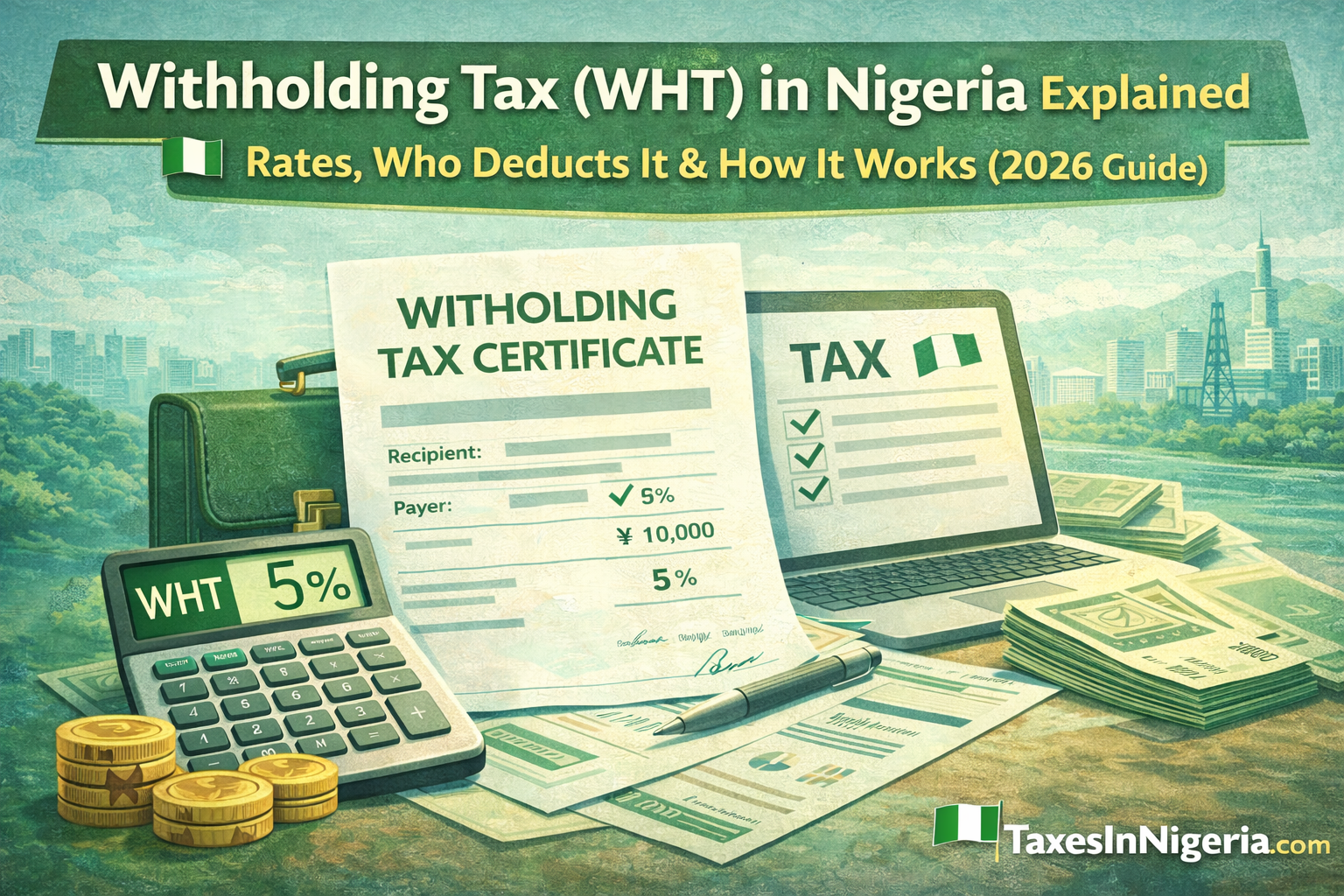
Withholding Tax (WHT) in Nigeria Explained: Rates, Who Deducts It & How It Works (2026 Guide)
Withholding Tax (WHT) in Nigeria is one of the most misunderstood taxes, even though it affects millions of everyday transactions. Many Nigerians first encounter WHT when they receive a payment that is less than expected, only to hear “we deducted withholding tax.” For freelancers, consultants, landlords, suppliers, and even registered companies, WHT often shows up quietly in contracts and invoices without a clear explanation of what it really means.
As Nigeria’s tax system continues to evolve, especially with reforms fully effective in 2026, interest in Withholding Tax (WHT) in Nigeria has grown significantly. Businesses are becoming more compliant, banks now ask for clearer tax records, and government agencies increasingly rely on digital reporting. Because of this, individuals and businesses want to understand how WHT works, who deducts it, who pays it, and how it affects their overall tax position.
This section introduces Withholding Tax in simple terms. It explains why WHT exists, how it fits into the Nigerian tax system, and why it is not a separate tax but an advance payment of income tax. Everything here is written for clarity and understanding, not as legal or professional advice, and reflects Nigerian tax practice as of 2026.
Section 1: What Is Withholding Tax (WHT) in Nigeria and Why It Exists
Simple meaning of Withholding Tax in Nigeria
Withholding Tax (WHT) in Nigeria is a tax mechanism where a portion of a payment is deducted at the source before the money reaches the person or business being paid. The party making the payment deducts the tax and remits it to the tax authority on behalf of the recipient.
Instead of waiting until the end of the year for someone to declare income and pay tax, the government collects part of that tax in advance. This is why WHT is often described as a prepayment of income tax rather than a separate or additional tax.
For example, if a consultant issues an invoice of ₦100,000 for professional services, the client may deduct ₦5,000 or ₦10,000 as withholding tax (depending on the applicable rate) and pay ₦90,000 or ₦95,000 to the consultant. The deducted amount is then sent to the tax authority and credited to the consultant’s tax record.
Why the Nigerian tax system uses withholding tax
The Nigerian tax system uses WHT to improve tax collection efficiency and reduce tax evasion. Many income earners do not receive fixed monthly salaries, making it difficult to track their earnings through PAYE alone. Withholding tax helps bring such income into the tax net gradually.
Some key reasons WHT exists include:
- Ensuring early collection of income tax
- Reducing the risk of non-payment at year end
- Encouraging proper record-keeping
- Bringing informal income earners into the formal tax system
Because Nigeria has a large informal economy, withholding tax plays an important role in capturing taxes from transactions that might otherwise go unreported.
Is withholding tax a separate tax?
A very common misconception is that Withholding Tax (WHT) in Nigeria is an extra tax on top of income tax. In reality, it is not.
WHT is:
- An advance payment of income tax
- A credit against final tax liability
- Not meant to increase total tax payable
When annual tax returns are filed, the WHT already deducted can be offset against the final tax due. If too much tax was withheld, it may result in a credit balance. If too little was withheld, additional tax may still be payable.
This is why proper documentation and receipts for WHT deductions are important.
Who administers withholding tax in Nigeria
Withholding tax is administered by tax authorities at both federal and state levels, depending on the type of income and the taxpayer involved.
At the federal level, the Federal Inland Revenue Service (FIRS) oversees WHT related to companies and certain categories of individuals. At the state level, state internal revenue services handle WHT for individuals under their jurisdiction.
Helpful official resources include:
- Federal tax authority information: https://www.firs.gov.ng/
- Tax Identification Number (TIN) registration: https://taxid.nrs.gov.ng/
- Joint Tax Board TIN services: https://tin.jtb.gov.ng/
These platforms help taxpayers register, track deductions, and verify compliance.
Types of income commonly subject to withholding tax
Withholding Tax (WHT) in Nigeria applies to many everyday transactions. Some of the most common include:
- Professional and consultancy services
- Contract payments
- Rent on property
- Dividends and interest
- Royalties
- Commissions and agency fees
This wide coverage explains why WHT affects freelancers, landlords, vendors, contractors, and companies alike.
Why WHT matters more in 2026
By 2026, Nigeria’s tax administration has become more digital and interconnected. Banks, corporate clients, and government agencies increasingly request TINs and proof of tax compliance before making payments. As a result, WHT deductions are now more visible and easier to trace.
This increased transparency means:
- Businesses are more careful about deducting and remitting WHT
- Individuals notice deductions more often
- Proper understanding of WHT is now essential
Knowing how Withholding Tax works helps taxpayers avoid confusion, disputes, and unnecessary fear when deductions occur.
How this guide is structured
This article explains Withholding Tax (WHT) in Nigeria step by step. After this introductory section, the next parts will cover:
- WHT rates and how they are applied
- Who deducts WHT and who bears the tax
- Practical examples using ₦ amounts
- How to claim WHT credits
- Common mistakes and FAQs
Section 2: Withholding Tax (WHT) Rates in Nigeria — Who Pays, How It’s Deducted & Real Examples
Understanding Withholding Tax (WHT) in Nigeria means knowing how much tax is deducted at source, who deducts it, and when it should be remitted to the government. In simple terms, WHT is not a random charge — it’s a portion of a payment that is withheld by the payer and sent directly to tax authorities as an advance payment of tax by the recipient.
This section breaks down typical WHT rates in Nigeria, shows how these rates apply to different payment types, and gives practical Nigerian examples you can relate to everyday financial situations.
What the Main Withholding Tax Rates in Nigeria Are
Although some rates vary by situation, most WHT deductions in Nigeria are based on flat percentages depending on the type of payment and whether the recipient is a resident or non-resident.
Typical WHT Rates in Nigeria (2026):
| Payment Type | Resident Rate | Non-Resident Rate |
|---|---|---|
| Contracts (goods & services not specifically listed) | 5% | 10% |
| Consultancy / Professional fees | 5% | 10% |
| Technical / Management services | 5% | 10% |
| Commission (sales, marketing) | 5% | 10% |
| Rent (land, buildings, equipment hire) | 10% | 10% |
| Interest (banks, bonds, securities)* | 10% | 10% |
| Dividends | 10% | 10% |
| Royalties | 10% | 10% |
| Director’s fees | 10% | 10% |
Many of these rates are the same for both residents and non-residents — for example, rent, dividends, and royalties are generally taxed at 10% whether the recipient is in Nigeria or abroad.
💡 Note: There have been specific directives requiring banks and financial institutions to apply 10% WHT on interest earned from short-term securities like T-Bills and corporate bonds as of late 2025/2026 reforms.
Why Different Rates Apply
Different economic activities attract different risk levels and revenue expectations for the government. For example:
- Contracts and services often have a lower rate (5%) because many small businesses operate in that space.
- Rent, dividends, interest and royalties are generally considered passive income and are taxed at a higher 10% rate, reflecting their potential value over time.
These rates align with the principle that WHT is an advance payment of income tax:
- When a payment is made, tax is collected at the point of payment.
- The withheld amount can then be claimed as a credit against the recipient’s tax liability for the year.
Who Deduces Withholding Tax
In Nigeria, the payer — the person or company making the payment — is responsible for WHT deduction. Then, the payer remits that amount to the government and issues a tax credit certificate to the payee.
Typical payers include:
- Companies paying suppliers or consultants
- Tenants paying rent to private landlords
- Banks paying interest to account holders or investors
- Organisers paying winnings from promotional or gaming events (where applicable)
- Payers of dividends to shareholders
For example:
- A company paying a consultant ₦200,000 for services might deduct 5% WHT (₦10,000) and pay ₦190,000 to the consultant.
- If a tenant pays ₦300,000 in annual rent, the tenant may deduct 10% WHT (₦30,000) before payment.
When Withholding Tax Is Remitted
By law, the withheld tax must be paid to the relevant tax authority within a specified timeframe — usually 21 days after the end of the month in which the payment was made. This applies for both federal and state withholding tax where applicable.
After remittance, the payer should:
- Issue a WHT credit certificate to the payee
- Retain proof of payment for compliance and record-keeping
- File relevant returns with the tax authority (for corporations usually via portals like TaxPro Max)
These steps help the recipient claim the withheld amount against their annual tax liability.
Practical Nigerian Examples
Example 1: A Freelancer Paid by a Company
A Lagos-based IT consultant invoices a company for ₦500,000. The company deducts 5% WHT (₦25,000). As a result:
- The consultant receives ₦475,000
- The company remits ₦25,000 to the tax authority
- The consultant uses the WHT certificate when filing annual income tax to reduce the final tax due
This prevents the consultant from paying the same portion twice.
Example 2: Landlord Renting Property
A small business leases an office space in Abuja for ₦1,200,000 per year. The tenant deducts 10% WHT (₦120,000) from the rent and pays ₦1,080,000 to the landlord. The landlord will claim the WHT certificate when filing personal tax returns.
Example 3: Bank Interest on Short-Term Securities
If an investor in Nigeria earns interest of ₦50,000 from a short-term T-Bill, a 10% WHT (₦5,000) may be deducted at the point of payment. The remaining ₦45,000 is paid to the investor. The withheld ₦5,000 is a credit against the investor’s annual tax.
Special Situations and New Categories
While the common rates above apply to usual business payments, recent regulations also introduced or clarified other categories:
- Payments for lottery winnings or gaming now attract WHT (e.g., 5% for residents, 15% for non-residents in some cases).
- Some sectors may have reduced rates for residents (e.g., construction services could be as low as 2% for some resident transactions under newer regulations).
These details may depend on updated guidelines from the tax authority and should be checked when relevant.
Key Takeaway on Rates
- WHT rates in Nigeria generally range from 5% to 10% for most payments made to residents and non-residents.
- Common payment categories include contracts, rent, dividends, interest, royalties, and services.
- WHT is withheld by the payer and credited to the payee’s final tax.
Section 3: How to Claim Withholding Tax (WHT) Credits, Penalties, Common Mistakes & FAQs
Withholding Tax (WHT) in Nigeria is an advance payment made on behalf of the payee by the payer. Once WHT has been deducted and remitted to the tax authority, the recipient can claim it as a credit against their annual tax liability. This section explains how to claim WHT credits, what happens when things go wrong, and answers common questions Nigerians search for about WHT.
How to Claim Your WHT Credit (Step-by-Step)
When a payer deducts withholding tax from your payment, they are required to:
- Remit the WHT to the tax authority
This must be done within the statutory time frame (usually within 21 days of deduction). It goes to either the federal or state tax authority depending on the payer and the nature of the payment. - Issue a Withholding Tax Credit Certificate
The payer should give you a certificate showing:- Amount of WHT deducted
- Date of deduction
- Tax categories
- Payer’s tax identification details
- Use the certificate when filing your tax return
When filing your annual personal income tax (for individuals) or company income tax return, you upload or present your WHT certificates. The total amount withheld is credited against your tax liability. For example:- If your annual tax due was estimated at ₦120,000
- And total WHT deducted for the year was ₦40,000
- Your final payable tax becomes ₦80,000 after credit
- Keep records electronically or physically
WHT certificates must be kept for compliance checks. Digital platforms and e-filing systems often allow uploading these certificates during return filing.
Penalties and Compliance Risks (What Happens If WHT Is Not Handled Properly)
Because WHT is treated as tax remitted on behalf of another person, there are consequences for not handling it correctly. These include:
For the Payer
- Late remittance
If the payer deducts WHT but delays sending it to the tax authority, penalties and interest may be charged for late payment. - Failure to issue WHT certificates
Not issuing proper credit certificates may cause issues for the recipient at filing time. Tax authorities may also impose fines for poor record-keeping. - Incorrect categorization of payments
Misclassifying payments can lead to wrong WHT rates being applied — for example, applying 5% on rent where 10% should be applied — and this may attract penalties.
For the Payee
- Failure to present certificates at filing
If you forget or lose your WHT certificates, you may not receive your credit. It’s important to keep electronic backups and printed copies. - Mismatch in records
When the tax authority’s remittance record doesn’t match what you present, an explanation or reconciliation may be required.
The best practice is regular reconciliation between the certificates you hold and the tax remittances on the tax authority’s record.
Common Mistakes Nigerians Make With WHT (And How to Avoid Them)
Here are frequent errors identified in practice:
❌ Assuming WHT is a separate, extra tax
WHT is an advance payment credit—not an additional charge you pay over income tax.
💡 Fix: Track your WHT certificates and use them when filing tax returns.
❌ Not obtaining a WHT certificate from the payer
Many recipients fall into this trap, particularly freelancers or small suppliers.
💡 Fix: Always request a certificate immediately after payment and keep it safe.
❌ Incorrect remittance by the payer
Sometimes businesses forget to remit WHT on time, leading to penalties.
💡 Fix: Remind or verify with your clients that remittance and certification have been done.
❌ Mixing up WHT and VAT obligations
VAT is a tax on consumption collected from the customer; WHT is a tax credit collected on behalf of the recipient.
💡 Fix: Understand the difference — VAT is not convertible into WHT and vice versa.
Frequently Asked Questions (FAQs)
What is the current rate for Withholding Tax in Nigeria?
Withholding Tax (WHT) in Nigeria generally ranges from 5% to 10% depending on payment type — for example:
- 5% on professional/consultant fees and contracts
- 10% on rent, dividends, interest, and royalties
Exact rates may vary with changes in law or specific state requirements.
How do I claim my WHT credit?
The payer must provide you with a Withholding Tax Credit Certificate showing the amount deducted. When you file your annual tax return (personal or corporate), you include this certificate so the tax authority can credit the withheld amount against your total tax due.
Can I get a refund if too much WHT was deducted?
Yes, when filing your annual tax return, if the total WHT deducted exceeds your actual tax liability, the excess may be refunded or carried forward according to tax authority procedures.
Do I need a TIN to receive WHT?
Yes. A Tax Identification Number (TIN) is often required. Employers and clients frequently request it before issuing payments that attract WHT, and remittances are matched to your TIN. You can register or retrieve a TIN at:
Is Withholding Tax refundable?
WHT itself is a credit against annual tax, not a direct refundable tax. If your total annual tax liability is less than your cumulative WHT credit, the excess may be carried forward or refunded, depending on tax authority rules.
Final Tips for Dealing With Withholding Tax in Nigeria
- Always request a WHT credit certificate when WHT is deducted.
- Match the withheld amount against your tax liability during annual filing.
- Keep records tidy and organized, whether you’re a freelancer, SME owner, or salaried worker.
- If you’re making payments that attract WHT as a business, use proper bookkeeping to avoid remittance and reporting penalties.
Conclusion: Withholding Tax (WHT) in Nigeria Made Clear
Withholding Tax (WHT) in Nigeria is a common part of doing business, earning income, and managing financial transactions. It may feel confusing at first, but at its core it is an advance payment of tax that helps the tax system capture revenue early and fairly.
By knowing the applicable rates, understanding who deducts it and when, and learning how to claim credits correctly, Nigerians across all walks, salary earners, freelancers, SMEs, and companies, can navigate WHT with confidence.
This article is updated for 2026 and reflects real practices in Nigeria’s evolving tax environment.