New Tax Laws in Nigeria Explained: What Changed, Who It Affects & What to Do (2026 Guide)
The phrase “New tax laws in Nigeria” (as many people type it when searching) refers to the wide set of tax reforms that Nigeria rolled out starting in 2025 and which came fully into force on 1 January 2026. These changes are intended to modernize the tax system, simplify multiple overlapping rules, and create clearer treatment for individuals, small businesses, and corporations. The reforms touch personal income tax (PIT/PAYE), company tax, VAT and other indirect taxes, and the way tax administration works across federal and state agencies.
Put plainly: the government rewrote large parts of the tax rulebook. That means everyday Nigerians, salary earners, freelancers, shop owners, and SMEs, will see differences in what is taxed, how tax is calculated, and when tax responsibilities begin (for example, certain exemptions and thresholds were introduced or raised). The reforms aim to make the system fairer by exempting low-income earners and easing tax burdens for very small businesses, while broadening the base so more people and companies participate in the formal system.
This first section explains the big picture in simple terms so you know why people are searching “New tax laws in Nigeria” and what the changes mean for common situations: getting paid as an employee, running a small shop, freelancing online, or setting up a company and opening a bank account. It is written to clarify, not to give legal advice, think of it as a plain-language map to help you understand where the new rules may affect your daily finances.
What the New tax laws in Nigeria mean — a simple, practical overview (Updated for 2026)
What changed — the headline items (easy summary)
The reform package replaces and consolidates older, scattered tax acts into a clearer framework. Key headline items many people feel immediately are:
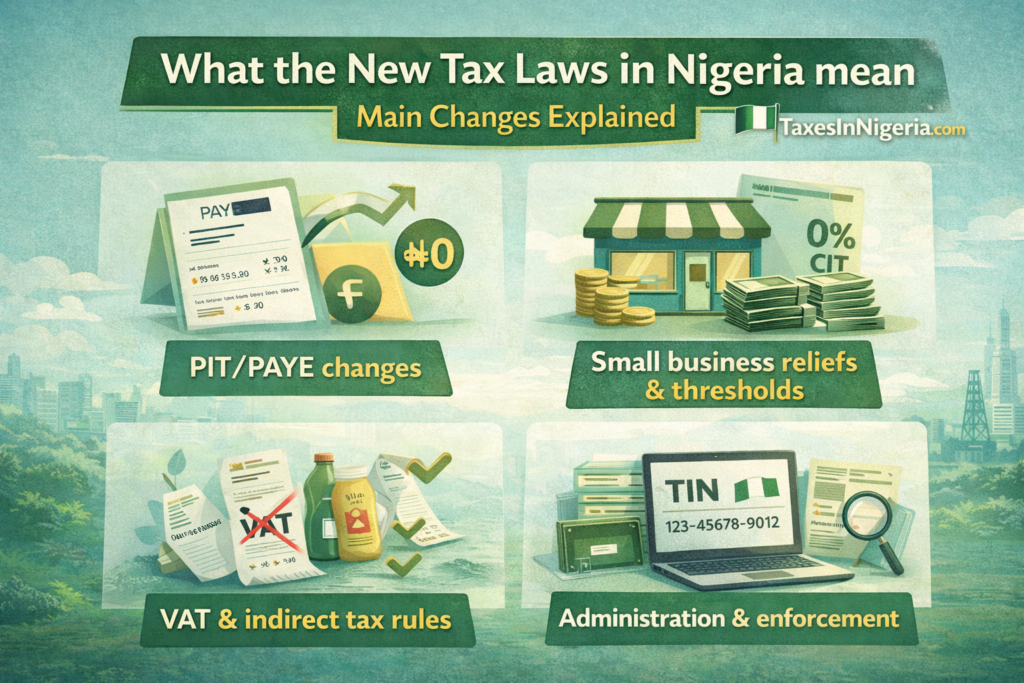
- Personal Income Tax (PIT/PAYE) changes: The rules were restructured into a more progressive format and tax-free thresholds were introduced for lower earners (for example, many materials summarizing the reforms note a tax-free band around ₦800,000 annual income for the lowest bracket). This means some low-income workers now pay little or no PAYE while higher earners may face revised bracketed rates.
- Small business reliefs and thresholds: The new laws create clearer definitions for “small companies” and provide substantial relief. In practical terms, some versions of the new rules treat companies under certain turnover thresholds (widely reported at ₦50 million in some commentary) as eligible for 0% Companies Income Tax. Different guidance and technical notes vary slightly by definition (some advisers mention up to ₦100m depending on criteria), so it’s important to check the exact test that applies to your business.
- VAT and indirect tax rules: The reforms clarified which goods and services are VAT-exempt, introduced 0% rates for essentials in some cases, and set clearer registration thresholds (for example, small sellers under certain turnover limits may not need to register for or charge VAT). These adjustments change how prices and receipts look at the point of sale.
- Tax administration and enforcement: The laws also modernize administration, more digital record-keeping, cross-checks with bank data, and clearer compliance steps for employers and businesses. This is paired with stronger penalties for non-remittance in some areas, though official guidance stresses that the focus is on bringing people into the system rather than punitive action.
Why these changes matter for everyday Nigerians (concrete examples)
- Salary earner (PAYE): If your annual pay is near the lower end of earnings, you may now fall under the exempt band and see little or no PAYE on your monthly payslip. If you earn more, the progressive bands mean tax is designed to be fairer across income ranges. Employers are expected to update payroll systems to reflect the new bands.
- Small shop owner or trader (SME): If your shop’s annual turnover is below the small-company threshold in the law, you may not pay Companies Income Tax and may be exempt from VAT registration — but you still need to register, keep records, and show compliance when asked by banks or suppliers. The goal is to make formalization less costly for micro-businesses.
- Freelancer or online earner: Platforms, payment processors and banks will increasingly request tax IDs and may ask for proof of registration. The reforms make it clearer how online incomes are treated and encourage freelance workers to register so their income is properly recorded and eligible for any allowable reliefs.
- Company owner: For incorporated businesses, the new tax regime changes how profit is assessed and introduces a simplified small-company test. Corporate filings, TINs and CAC records need to match to avoid verification problems.
A quick caution and how to stay safe
These reforms are large and complex, and while the headlines are right — relief for many and new rules for others — the technical details matter (how “turnover” is calculated, fixed-asset tests, timing of crossing thresholds, etc.). Practitioners (tax advisors, accountants) are still digesting detailed guidance and the tax authority has issued clarifications and FAQs in stages. For up-to-date, official guidance, check primary sources such as the Federal tax authority’s publications and the government gazette. Also be aware that some press coverage shows debate and clarifications were still happening as implementation started.
Where to read the official texts and guidance (quick links)
- Official announcement / government page about the reform timing and commencement.
- Practical summaries and professional guidance from major accounting firms (for example PwC, Baker Tilly) which explain the PIT and small company tests.
- News coverage summarizing the political and implementation issues (Reuters summary).
Practical Takeaways — What the New tax laws in Nigeria mean for salary earners, SMEs and registered companies (Step-by-step, updated 2026)
The New tax laws in Nigeria introduce practical changes that affect how people and businesses manage payroll, record keeping, and tax registration. This section breaks those changes into clear steps you can follow. Read the parts that apply to you — salary earner, small business owner, or company director — and use the links provided to update records or register where needed.
Quick reminder: this is an explanatory guide, not professional tax advice. Use the official links below and consult a tax practitioner if you have complex situations.
For Salary Earners — what to check and do next
The new rules change PAYE calculations and introduced a tax-free band for lower incomes. Here’s a short checklist to follow:
- Check your payslip now.
Look for the PAYE line and the taxable pay figure. With the New tax laws in Nigeria, many low-income earners see reduced or zero PAYE if annual income falls within the tax-free band (for example, around ₦800,000 per year in the headline reforms). If your monthly payslip shows PAYE while you believe you fall into the exempt band, ask HR/payroll for clarification. - Confirm your TIN is on record.
Employers often request your Tax Identification Number (TIN) for payroll. If you don’t yet have a TIN, retrieve or register one via the official portal: https://tin.jtb.gov.ng/ or the national portal at https://taxid.nrs.gov.ng/. Having a TIN helps match your PAYE to your tax record. - Ask HR to update payroll software.
Payroll systems require configuration to reflect the new bands. A short email to HR asking whether the company has implemented the New tax laws in Nigeria rates will often trigger an update if it’s needed. - Understand reliefs and allowances.
If you contribute to a pension or have approved allowances, confirm these are being applied before calculating taxable income. These reliefs can reduce monthly PAYE. - If switching jobs, share your TIN.
A TIN ensures continuity of your tax history and prevents double reporting or mismatches when employers report PAYE to the tax authority.
Example (salary earner):
If you earn ₦80,000/month (₦960,000/year), under the New tax laws in Nigeria you might fall just above or within a lower tax band depending on reliefs. Showing your pension contributions or allowable reliefs may reduce taxable income below the threshold and reduce monthly PAYE.
For SMEs and micro businesses — registration, small-company rules, and VAT
The reforms aim to make formalization less costly for small businesses. Here’s how to proceed:
- Check your turnover vs small-company threshold.
The New tax laws in Nigeria introduced clearer thresholds (widely referenced at ₦50 million turnover) for small-company relief. If your business turnover is below that number, you may qualify for 0% Companies Income Tax or simplified filing. Confirm the exact test in your sector and check guidance from an accountant. - Register a TIN for the business (if not already).
Use the corporate option on the Tax ID portal: https://taxid.nrs.gov.ng/ (enter your CAC RC/BN number). Banks typically require corporate TINs for business accounts. CAC registration (https://www.cac.gov.ng/) is also necessary before some processes. - Decide on VAT registration.
New guidance clarified VAT registration thresholds. If your annual taxable turnover is below the threshold, you may not need to charge VAT — but voluntary registration is possible. Check state and federal VAT guidance and the FIRS/NRS pages for details. - Keep proper records for turnover and expenses.
To benefit from small-company rules you’ll need verifiable records. Simple bookkeeping (revenue, receipts, supplier invoices) protects you if a bank or tax office asks for proof. - Open a proper business bank account.
A corporate bank account linked to CAC and TIN makes it easier to show credible records and obtain services like loans. Banks often ask for CAC, TIN and ID for signatories.
Example (SME):
A boutique with annual sales of ₦30,000,000 may fall below the small-company threshold. If properly registered and keeping records, the New tax laws in Nigeria could reduce formal CIT obligations and simplify filings — freeing cash to reinvest.
Useful links:
- Tax ID portal: https://taxid.nrs.gov.ng/
- CAC registration: https://www.cac.gov.ng/
- FIRS overview: https://www.firs.gov.ng/
For Registered Companies — compliance, filings, and verification
If you run an incorporated business, the New tax laws in Nigeria introduce clearer profit assessments and administrative steps.
- Confirm corporate TIN and CAC details match.
Mismatched records cause verification failures. Use the tax portal and your CAC profile to ensure the registered company name, RC/BN, director details and TIN are consistent. - Review company tax computations under the new regime.
Profit calculation rules (allowable deductions, depreciation, capital allowances) may have been clarified or adjusted in the reforms. Work with your accountant to recalculate CIT based on the new law. - Update payroll and withholding tax processes.
If your company deducts PAYE or withholds tax on payments to contractors, ensure systems reflect the New tax laws in Nigeria and updated rates/thresholds. - Prepare for digital filing and cross-checks.
Administration changes emphasize digital records and cross-checking of bank data. Consider moving to cloud accounting or keeping clean electronic records. - Check eligibility for incentives (sector-specific reliefs).
Some industries (agriculture, tech zones, export services) have targeted incentives. See professional guidance for sector tests.
Example (registered company):
A small tech startup with ₦40,000,000 annual turnover should confirm whether it falls under the small-company definition and whether any sector incentives apply. Correct CAC-TIN matching will reduce onboarding friction with banks and investors.
Quick operational checklist (all audiences)
- Retrieve or register TIN: https://taxid.nrs.gov.ng/ or https://tin.jtb.gov.ng/
- Ensure NIN/BVN/CAC records are accurate for matching.
- Update payroll with new PAYE bands (salary earners and employers).
- Keep clean records of turnover and expenses (SMEs and companies).
- Check VAT registration thresholds if you sell goods or services.
- Use FIRS/NRS/Federal pages for official publications and circulars: https://www.firs.gov.ng/
Worked Examples, FAQs, and Final Summary on the New tax laws in Nigeria (Updated for 2026)
This final section brings the New tax laws in Nigeria down to earth with simple, worked examples in ₦, answers to the most common questions Nigerians ask, and a clear wrap-up of what to remember going forward. The goal is clarity — how the new rules show up in real life, where to check official information, and how to avoid common mistakes.
Worked examples (simple, real-life scenarios)
Example 1: Salary earner on a modest income
- Monthly salary: ₦70,000
- Annual income: ₦840,000
Under the New tax laws in Nigeria, low-income earners benefit from a tax-free band and reliefs that reduce taxable income. Depending on allowable reliefs (for example, pension contributions processed by payroll), PAYE on this income may be very low or zero. If PAYE appears on the payslip, the employee can ask HR to confirm that the updated bands are applied.
What to check:
- Payslip PAYE line
- Employer payroll update status
- TIN on record (retrieve via https://taxid.nrs.gov.ng/)
Example 2: Small business below the small-company threshold
- Annual turnover: ₦28,000,000
- Business type: Registered SME (boutique/retail)
With turnover below the commonly referenced small-company threshold (often cited around ₦50m in guidance), the New tax laws in Nigeria may allow 0% Companies Income Tax. The relief exists to encourage formalization, not to eliminate record-keeping.
What still matters:
- CAC registration (https://www.cac.gov.ng/)
- Corporate TIN
- Basic books (sales, expenses)
- VAT decision (below threshold may not register)
Example 3: Freelancer earning online
- Monthly receipts: ₦350,000
- Annual receipts: ₦4,200,000
A freelancer receiving payments through banks or platforms may be asked for a TIN. Under the New tax laws in Nigeria, clarity around reporting and reliefs means registration and clean records help avoid account limits or onboarding delays.
What helps:
- Individual TIN retrieval
- Clear bank records
- Simple expense tracking (internet, tools)
Example 4: Growing company crossing a threshold
- Turnover last year: ₦48,000,000
- Turnover this year: ₦62,000,000
If a company crosses the small-company threshold during the year, the tax position can change. The New tax laws in Nigeria emphasize accurate timing and thresholds, so companies should review status annually and update filings accordingly.
What to do:
- Reassess eligibility at year-end
- Update payroll and filings
- Keep CAC/TIN records consistent
Common mistakes to avoid under the new rules
- Assuming “no tax” means “no registration.”
Even where tax payable is zero, registration and records still matter for banking and compliance. - Ignoring name mismatches (NIN/BVN/CAC).
Mismatches cause TIN verification failures. Update primary records early. - Charging VAT without registration (or vice versa).
Know the VAT threshold that applies to your business and act consistently. - Using third-party “TIN agents.”
Official portals are free. Avoid unnecessary fees and data risks.
Frequently Asked Questions (FAQs)
1.What are the New tax laws in Nigeria?
The term refers to Nigeria’s comprehensive tax reforms that took effect from 1 January 2026, covering personal income tax, company tax, VAT, and tax administration. They aim to simplify rules, exempt low earners, and support small businesses.
2. Who benefits most from the New tax laws in Nigeria?
Low-income salary earners and small businesses benefit from higher thresholds and exemptions. SMEs below the small-company turnover limit may pay little or no Companies Income Tax, provided they register and keep records.
3. Do I still need a TIN if I don’t pay tax?
Yes. A TIN is an identification number used by employers, banks, and government agencies. It’s useful even when tax payable is zero.
4. Where can I register or retrieve my TIN?
Use official portals:
5. Do the new laws change VAT rates?
The reforms clarify VAT registration thresholds and exemptions for certain essentials. Whether you charge VAT depends on your turnover and the goods/services you provide.
6. Are the New tax laws in Nigeria final?
The core laws commenced in 2026, but guidance, circulars, and clarifications continue to be issued. Always check official updates from the tax authority.
Final Summary
The New tax laws in Nigeria mark a major shift toward a simpler, more inclusive tax system. For salary earners, the changes can mean lower PAYE at the bottom end of income. For SMEs, clearer thresholds and exemptions reduce the cost of formalization. For companies, improved administration and digital records aim to make compliance more predictable.
The key takeaway is balance: register, keep records, and understand where you fall under the thresholds. Doing so helps you benefit from reliefs built into the law while staying aligned with Nigeria’s evolving tax system.